A personal profile is your opportunity to set out your stall within seconds. When you first meet a recruiter, they'll often ask, "Tell me about yourself". Your CV's personal profile is the paper version of this.
Often regarded as one of the most difficult sections of your CV to prepare, you need to concentrate on extracting evidence from your career that matches the role you're applying for.
What is a personal profile?
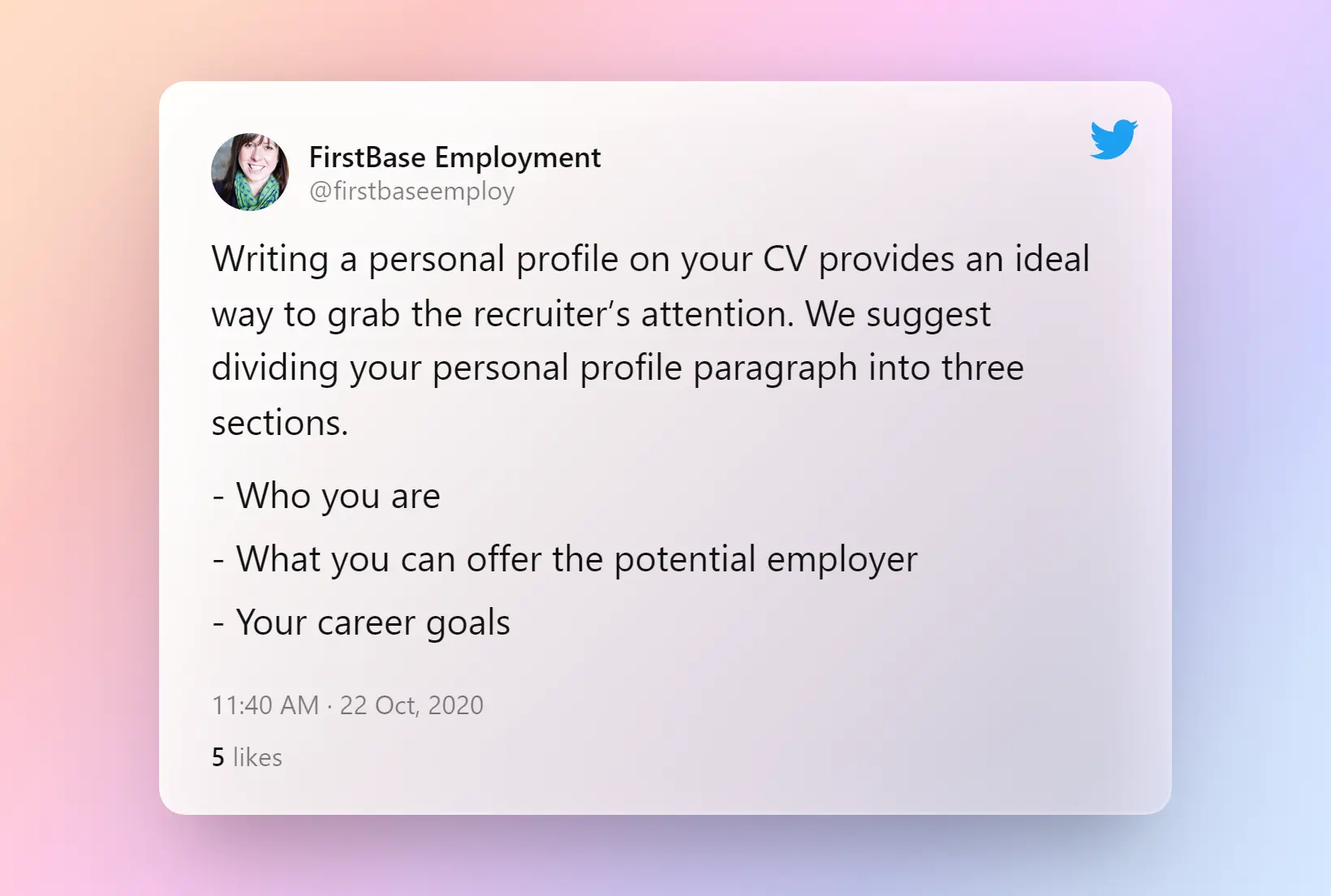
A CV's profile (often referred to as a personal statement or just "introduction") is a few brief lines at the top of your CV providing recruiters with a quick overview of you and your experience without having to read your entire CV. When reading a personal profile, recruiters essentially want to know:
-
Who is this candidate? Your professional identity, seniority level, and area of expertise.
-
What have they done? Relevant experience, key achievements, and quantifiable wins.
-
What can they offer us? The specific value you bring to this role and this organisation.
Personal Profile Tips
-
Tweak the personal profile for every job application The more experience you have, the more this tip applies. Go through the job description with a fine-toothed comb to extract the skills and keywords they use, then mirror that language in your profile. This shows the recruiter what you can and will do if they recruit you — and becomes even more useful when ATS systems scan your CV.
-
Avoid overused clichés If we had a pound for each time we read "hardworking" and "works well in a team" in a CV, we'd be on a tropical island rather than writing this article. A CV should tell a recruiter what makes you different — clichés have the opposite effect. Besides, wouldn't a recruiter simply expect every candidate to be "hardworking"?
-
Avoid pronouns in your profile (and throughout your CV) You can write your personal statement in the first or third person, but you don't need to use 'I', 'he' or 'she' — its use is implied. Try starting each line with a power verb such as "Implemented" and cut the pronoun. "Implemented a marketing campaign resulting in…" immediately attracts attention.
-
Be factual 90% of personal statements are full of hot air. Avoid overstating your skills — a recruiter will see straight through it. Include facts you can back up: how many years' experience you have, and definitely mention figures relating to past achievements such as sales increases and the number of staff you've led.
-
Touch on your future ambitions Although your profile is primarily needed to highlight what you're bringing to the table, it's also worth including a line about your future goals. If you're returning to the workplace after a career break, mention it. If you've recently completed a degree and are looking for an entry-level role, let the recruiter know.
-
Don't make your personal profile too vague Be specific about your achievements and skills. Instead of saying you "contributed to sales growth," provide numbers or percentages to demonstrate the actual impact of your work.
-
Avoid excessive use of industry-specific jargon While it's good to demonstrate industry knowledge, avoid jargon that might not be understood by everyone — including HR generalists or ATS systems. Focus on clarity and simplicity.
-
Keep the tone natural Once you've prepared the content, read your profile out loud to ensure it reads naturally.
Follow a Consistent Structure
An easy way to tailor each profile is to follow a core structure, such as:
- Success in…
- Recognised for…
- Proven record for…
Example: "Sales Director with seven years' success in fast-paced telecommunications companies. Recognised for expertise creating effective sales strategies and proven record increasing sales by up to 10% in competitive settings."
Example of a CV Personal Profile
"Results-driven marketing professional with over five years' international experience developing and executing successful digital marketing campaigns for global brands within budgets of up to £10M. Proven track record of driving revenue growth through strategic SEO, SEM, and social media initiatives. Leveraged skills in data analysis and trend analysis to optimise marketing strategies while leading high-performing teams of up to 20 staff."
In the above example, the Marketing Manager candidate starts by mentioning their years of experience and expertise in digital marketing. They then provide specific skills such as SEO, SEM, and data analysis, along with their ability to drive revenue growth. Finally, they reference their leadership experience. This profile is tailored to a specific job and showcases the candidate's qualifications and aspirations effectively.

Common Questions
Frequently Asked Questions
No. Objective sections tend to be found in US-style résumés rather than CVs. However, touching on your objectives is always a good idea — without including a separate "Objectives" section.
There's no fixed rule, but aim for one paragraph. If your core "story" isn't conveyed within five or six lines, it's probably too complicated. Aim for 200–300 words as a maximum.
In my experience, a personal profile is one of the most important aspects of your CV — second only to the achievements within your employment history. The majority of recruiters will expect one and find it unusual to read a CV without a profile. For further context, see our guide on what makes a good CV.
More Profile Examples
Profile for a retail professional in customer service

Profile for a recent Electrical Engineering graduate

Need help writing your personal profile?
Our expert writers craft compelling, tailored personal profiles that make recruiters stop and read on.