

If someone told you there was a way to guarantee your CV is picked out by ATS scanning software, you'd be interested. If they then told you this method involves hiding a string of keywords in your CV using white font - invisible to the human eye but readable by automated software - would you still be interested?
This article explains what the white font trick is, why it used to work, and why using it in 2026 is likely to do far more damage than good.
What are Applicant Tracking Systems (ATS)?
ATS are used to automate the recruitment process by removing the human element from initial candidate selection. Recruiters use ATS to build job descriptions that are integrated into application portals. Candidates upload their CV directly, which is then filtered by the system's algorithms before any human sees it.
of Fortune 500 companies use ATS software, and adoption among mid-size UK employers now exceeds 75%. If you're applying online, your CV is almost certainly being screened before a human reads it.
What's Wrong with ATS?
For candidates and CV writers alike, ATS can be deeply frustrating. Even though they are now near-universal, they are far from perfect. If the formatting of your CV isn't right, the ATS will struggle to parse it correctly. They dislike text boxes, complex formatting, and heavy use of colour. You could be the ideal candidate - but a simple formatting error can prevent you from being considered at all.
The "Rejection System" Problem
Research suggests ATS systems eliminate up to 75% of candidates before a human recruiter is ever involved. This is why so many well-qualified people struggle to get responses - their CV simply never reached a person.
How Does the White Font Trick Work?
The basic principle is straightforward: fill the empty spaces of your CV with text written in white font. Invisible on a white page, but readable by an ATS scanning for keywords. Some candidates have even copied entire job descriptions word-for-word into their CV using white text, artificially inflating how many times key terms appear and making themselves seem more relevant than they are.
Here is a typical example of how it works in practice:
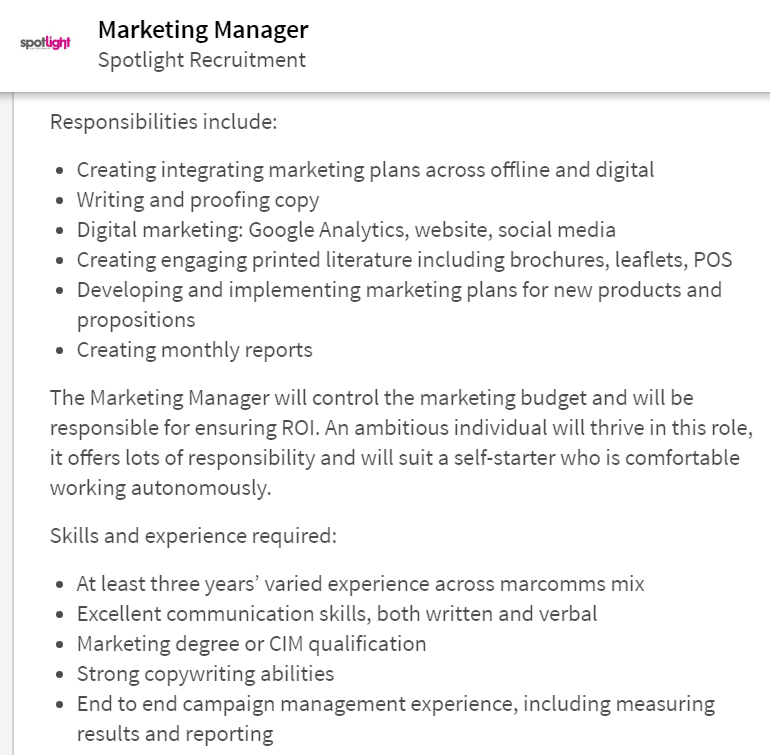
In the above example, the skills and experience required include communication skills, experience across the marcomms mix and strong copywriting abilities. A candidate using white text to manipulate the ATS would seed those exact phrases throughout their CV in white font, artificially increasing their keyword match score.
Does the White Font Trick Still Work?
It used to. But ATS technology has evolved significantly. Modern systems are specifically designed to detect hidden text, font colour manipulation, and keyword stuffing. What once slipped through unnoticed now triggers automatic flags in many platforms.
Why ATS Will Catch It
- Modern ATS flag unusual keyword density automatically
- Many systems now detect font colour as part of their parsing logic
- AI-powered screening tools cross-reference keyword frequency against content coherence
- Enterprise ATS platforms (Workday, Greenhouse, Lever) have built-in manipulation detection
Why Humans Will Catch It
- Experienced recruiters know the trick well
- A simple Ctrl+A and font colour change reveals everything instantly
- AI screening summaries will often surface hidden text anomalies
- If caught, you will almost certainly be blacklisted - not just rejected
Can I Check My CV Against an ATS?
This is one of the most common questions we receive. The honest answer is: not reliably. There are pushing 200 different ATS platforms in active use, and they all parse and score CVs in slightly different ways. Oracle Cloud (previously Taleo) remains a major player in enterprise recruitment. Other widely used systems include Workday, Greenhouse, iCIMS, and Lever. There is no single test that covers them all.
What Should You Do Instead?
The Legitimate Alternative: Honest Keyword Optimisation
Rather than hiding keywords, use them properly. Read the job description carefully and mirror its language naturally within your personal profile, skills section, and bullet points. This is the foundation of applying SEO principles to your CV and LinkedIn profile - a legitimate and highly effective approach that satisfies both the ATS and the human recruiter who reads it next.
For a full guide to getting your CV through ATS legitimately, see our ATS-friendly CV guide.
Need help getting past ATS - legitimately?
Our expert writers know exactly how to optimise your CV for both automated screening and human review, without any of the risk.