
As one of the UK's leading recruiters — accounting for nearly half a million employees — a career as a Civil Servant can be a rewarding one. In fact, in 2020, the Civil Service was named number 1 in the 'The Times Top-100 Graduate Employers' listing. The diversity of roles available provides an opportunity not found in the private sector – from working within one of 24 ministerial units to defining critical policies; and most with above-average salaries and pensions.
In this article, we advise on how to tailor your CV to increase your chances of securing a role within the Civil Service. While this guide focuses on the UK Civil Service, these principles apply across the broader public sector, including roles within the NHS, local authorities, and non-departmental public bodies (NDPBs).
Applying for Public Sector and Civil Service Roles
There are multiple pathways into the Civil Service, including apprenticeships, and internships targeting undergraduates from diverse backgrounds, with starting salaries of around £27,000 (rising to £55,000 upon promotion).
Mapping your Civil Service CV to Behaviours
When applying for a role within the Civil Service, a set of "behaviours" are used to determine your fit for a specific role. These behaviours include leadership, delivering at pace and making effective decisions. Spend time articulating how you can demonstrate experience in these areas when preparing your CV.
Behaviour-related questions are used to provide recruiting managers with the data needed to identify your fit and predict your performance for a specific role. This is beneficial to both parties, as a candidate who fits well within a role, is more likely to be happy, and therefore perform better.
Backup your Claims with Examples
You're no doubt aware of the need to blow your own trumpet within a CV, and the importance of achievements. However, with Civil Service applications, the ability to quantify your claims with specific examples of "how" you achieved something is even more important.
Use the STAR Format
Consider adopting the STAR (Situation, Task, Action, Result) approach to structure your CV (and personal statement – more on this below). We speak more about the STAR CV here, but essentially, this format can help you in accurately showcasing your skills and achievements in line with the Civil Service's behaviours.
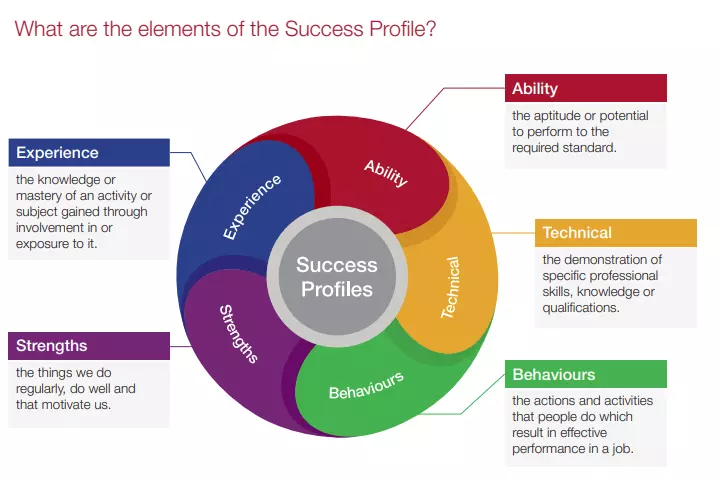
The 5 Elements of Success Profiles
When tailoring your CV for the Civil Service, you must align your experience with these five pillars used by hiring managers to assess candidates:
-
1
Behaviours The actions and activities that result in effective performance in a job.
-
2
Strengths The things you do regularly, do well, and that motivate you.
-
3
Ability Your aptitude or potential to perform to the required standard.
-
4
Experience The knowledge or mastery of an activity or involvement in an event.
-
5
Technical The specific professional skills, knowledge, or qualifications required.
Essential Public Sector Keywords
To pass the initial screening, ensure your CV includes these high-impact terms where relevant:
- ✅ Stakeholder Engagement
- ✅ Strategic Delivery
- ✅ Value for Money (VfM)
- ✅ Governance & Compliance
- ✅ Public Accountability
- ✅ Continuous Improvement
- ✅ Diversity & Inclusion
- ✅ Collaborative Working
In addition, spend some time reading up on Success Profiles. These frameworks are used within the Civil Service to assess experiences, abilities, strengths, behaviours and technical skills required – not just from your CV, but also your application form, interview, role-play exercises and personality tests.
Include Hobbies (Yes, Really!)
Usually, we advise against including hobbies in a CV. However, for Civil Service CVs, it's a good idea to include them.
Key Differences: Civil Service CV vs. Private Sector CV
If you are moving from a corporate role to the public sector, your standard "private sector" CV may not hit the mark. While a commercial CV focuses on profit and market share, a public sector CV prioritises accountability, process, and measurable service delivery.
| Feature | Private Sector CV | Civil Service / Public Sector CV |
|---|---|---|
| Primary Focus | Profit, ROI, and commercial growth. | Public value, policy adherence, and service impact. |
| Key Terminology | "Revenue," "Sales," "Customers." | "Stakeholders," "Citizens," "Value for Money." |
| Evidence Style | Brief highlights of responsibilities. | Deep, STAR-based evidence of Behaviours. |
| Length | Strictly 2 pages. | Up to 3 pages (to allow for STAR examples). |
| Formatting | Creative/modern layouts are fine. | Clean, structured, and often anonymised. |
The most significant shift is the move toward evidence-based writing. In the private sector, saying you are a "strong leader" might suffice; in the Civil Service, you must provide a specific instance of how you led a team through a challenge, mapped directly to the Success Profile framework.
Common Questions:
I've heard the Civil Service often prefers using anonymised CVs. Is this true?
Yes. These are often called blind CVs.
How long should a Civil Service CV be?
When writing a CV for the public sector, brevity is still key. We recommend no more than two to three pages (depending on experience level).
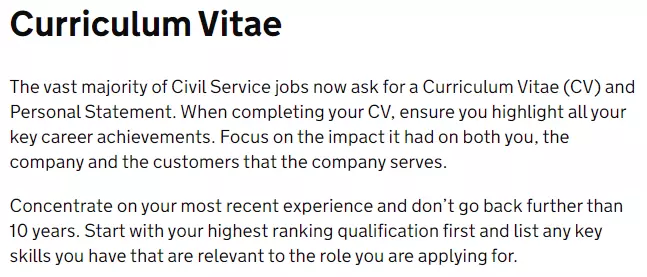
Should I include my full career history?
As you can see below, the guidelines state to not go back more than a decade:
Does a CV for the Civil Service need to be formatted differently?
No, the "normal" rules for writing a good CV apply.
What's a Statement of Suitability, and should this go in my CV?
This document should be used alongside your CV, rather than within it. This is a document of up to 1,250 words to expand upon the content of your CV in more detail.
Other Useful Links:
- Match your skills and experience with a role using the Civil Service's career matcher service — https://www.civil-service-careers.gov.uk/career-matcher
- Read about writing a personal statement for the Civil Service — https://www.gov.uk/government/organisations/civil-service/about/recruitment#completing-your-personal-statement
This article contains public sector information licensed under the Open Government Licence v3.0 (http://www.nationalarchives.gov.uk/doc/open-government-licence/version/3/).
Ready to secure your Civil Service role?
Don't leave your application to chance. Our expert writers specialise in Success Profiles and STAR-based evidence.
- ✅ ATS-Optimised: Pass public sector filters.
- ✅ Evidence-Led: Mapped to Behaviours.
- ✅ Full Support: 1-year of free edits.